








10.19.2011

Interview: Talking color with Alex Maas of the Black Angels

In a hue of red-orange...

The black alliance was broken last year when the Black Angels canceled their opening set for Black Mountain on the Dropout Boogie tour, but this Friday they make a welcome return to Headliners Music Hall, this time as a headlining act. Sludgy shoegazers Dead Meadow are set to open with Spindrift; expect to hear a dynamic of heavy psychedelia and low-key gypsy rock jams to build anticipation.

I caught up with guitarist/vocals man Alex Maas who suffered from a hernia on their previous tour, resulting in a few canceled shows including Louisville. Now in full health, Alex took some time with me to reflect on visual songwriting, black metal and describing the unknown.

When you combined your first two EPs for Another Nice Pair, were any of these older songs reworked in the process of compiling the release?

It was more of a compilation because those songs were limited presses off records. I think there’s only 1,000 copies of each, so for bigger distribution we thought, “okay a lot of people haven’t heard these songs. let’s release them. ” A lot of people were asking of them.

Your style has changed since 2005 when these were released, have you also adapted this transition when you play these older songs live?

Yeah, we have. With a song, the more you play it, the better it gets. That’s my opinion. We’re playing a little differently now.

In another interview you said that your music was a way to commune with the unknown and unexplained. What exactly has that entailed for you?

For me it’s less of a communication between the two and more our descriptions of the unknown. It’s hard to communicate with the unknown if it’s unknown, right? It’s more our way of expressing these kind of mysteries. The unknown is really interesting. You don’t know what happens when you die-- not that you have to know, or that you need to know. The unknown has always been kind of a point of inspiration for us.

Do you feel like you’ve made discoveries from creating this music that moves you?

Yeah, I think we’ve definitely pushed ourselves not to sound cheesy and pushed ourselves into different realms. Whether it be a spiritual thing, or something a lot more simple than that. When we’re experimenting with different sound, I definitely think it’s a way to time travel and kind of get lost.

You’ve coincidentally toured and have been associated with bands that also use the word “black” in their name. For the Angels, what does black mean to you?

It’s the opposite of light. [Laughs] We got our name from the Velvet Underground song “The Black Angels Death Song.” As far as touring with bands with “black” in their names- The Black Keys and Black Rebel Motercycle Club being the two off the top of my head, it was really amazing to be able to tour with those bands. We’d always been big fans of them and when the opportunity presented itself to tour with these bands for the first time, I was like “wow, awesome.” Obviously with Black Mountain as well. It wasn’t until our first tour was booked that I’m like “man, we keep playing with these Black bands.”

I know! Such a weird coincidence.

Yeah, and it honestly wasn’t like “we’re only gonna tour with these bands.”

Black to me isn’t as evil as everyone thinks. I mean, half of the world is black when there’s no light. If you think it’s a bad connotation. It’s always been a darker people color throughout literature. To me it doesn’t really have that feeling.

Speaking of color—on your song “Deer Ree Shee,” is that a tambura you used for the drone?

Yes, that’s a tambura and a sitar as well.

In classical Indian music the feeling or emotion of a song is called the rasa. Would you say that you take this same approach to writing music?

Yeah. That’s a good description of the way we write music; it’s about the feeling. We used to get a lot of slack about being a band like “oh, this is too simple, or there’s only note, maybe one or two changes...”

That’s how a lot of that classical music was, though.

Yeah, and that’s not something that we sought out to do. Simple was good. It was easy to get moved by a certain mood or certain style, like the tambura or something. Like whenever you hear [plays notes on guitar], you play these strings, and you repeat them over and over, it’s almost like the instrument is breathing. And it’s breathing inspiration and life into a potential song. And the repetitive nature of that has its own loop. It’s a tone thing, like it’s living. A lot of times the music comes and then we’re just describing the images that we hear, or the images that we see. It is connected to your limbic system, which is where all your memories and images are stored. And so it makes sense to how we make music--our band specifically. A lot of times, it’s the music first and then we’re just telling the story afterward of what the music is telling us.

Right, so it’s your interpretation of the music— more visual.

Yeah, it’s a total visual thing. Until I realized how the human body works—I was always perplexed as to how that happened—how do we write a song? People would ask us. It’s hard and different every time. [that’s what she said!] Knowing that has enabled me to go to that place and be okay feeling like “this might be nonesense, but I’m gonna say it anyway.” I make a lot of headway that way, in terms of songwriting.

Definitely, because it becomes a more natural thing and you can make it a mindstate. Which is awesome.

Yeah, and to play these songs live in front of people, you have to go back to that spot. If you don’t, you’re probably not going to be feeling it. It’s almost impossible to be into it every single time. I have a hard time with people I know seeing the same songs played over and over, so I like to keep it fresh and play a different set list every night. To me it’s more real as to where the music came from and how it’s being projected.

Do you ever get reoccurring visions of color?

Red and orange, for some reason. It’s something I’ve talked about with friends. It’s like a tinted hue of orange. I don’t know why it is or what it means, but for me those two colors...it’s almost like a sepia. A red-orange that kind of goes back and forth. I first remember seeing that when I was little, like if I was sick, everything would have this weird hue.

I know what you’re saying, like if you closed your eyes?

Yeah, it’s really tripped out. It was really strange. I remember that and I don’t know if it’s because you’re sick and your mind isn’t well--something is happening and going on in there. Whenever we’re writing music, I had that same kind of indescribable hue that hazed over. And it’s not always there, but it’s on and off.

That’s a really intense color, too.

Yeah, I remember when I was younger and had the flu, kind of hallucinating. It has a kind of eerie feeling to it. But it has a negative connotation. I think of seeing it when I was younger, and I’m like “ugh.”

We’re still on the subject of color, but moving to more rapid fire questions. I’ll give you the choice of two black things and you name your preference. Black eye vs. Black tongue?

Black eye.

Black coffee vs. black tea?

I’m a huge tea drinker, but I like black coffee. I don’t put cream in either one.

Black cats vs black girls?

Black girls

Black metal vs. black light?

Black light

Black light? So are you a raver?

[Laughs] No, I’m not a raver. I was at a couple parties when I was a teenager, but I’m not a raver. I’ve never been into black metal. I never got big metal into it at all. If the right person turned me on to it, I’d probably be into it. I’m not a huge black light fan, but I remember being at the skating rink when I was younger and I’d wear a white shirt, and it would look so awesome.

It’s really intelligent, the music they play [in black metal].

Yeah, it’s really complex.

It’s almost like a classical composition, really in-depth, or like hitting 3 notes on a scale. It never was for me. Probably didn’t have the patience or wasn’t good enough to play metal.

Yeah, for me it’s only good at the right times.

Yeah, I could totally see that.

Blackberries vs black beans?

Blackberries

You don’t like burritos?

I do. I like black beans, but I was mainly thinking of the antioxidant value the black beans have versus blackberries. Antioxidants over no antioxidants, I’m going to choose the antioxidants. Black metal and blacklight...So what’s the best time to listen to black metal?

Only when there’s a funky bass. Because if it’s not funky, it doesn’t do it for me.

It’s an isolated dichotomy. The funky bass would even out the note riffs of the black metal.

Yeah especially in jazzy progressive metal. I’m still slowly getting into the pool of metal because I’ve been avoiding it all these years.

Yeah, I hear you.

Black Sabbath vs Black Francis?

Frank Black is a really good songwriter, but I’d probably have to go with Black Sabbath. My sister always listened to the Pixies growing up, I do like them. But I have to say Sabbath.

Black Mountain vs Pink Mountaintops?

Ah shit, you had to throw that one in there. Pink Mountaintops. It has to do with the music for sure, because Black Mountain is more like metal and Pink Mountaintops is more like the Velvet Underground.

I’ll have to agree with you on the Pink Mountaintops. The electronic stuff [on Axis of Evol] definitely changes it up. It’s a nice break.

Chris Farley Black Sheep or killer Black Sheep?

Killer black sheep? I know of the one with Chris Farley, but is that a movie?

There’s one with Chris Farley and the other is about sheep that murder people.

Oh, that sounds awesome. But because I haven’t seen it, I’ll have to say [Chris Farley] Black Sheep.

The Black Angels play with Dead Meadow and Spindrift on Friday, Oct. 21 at Headliners Music Hall. Tickets available through ear-X-tacy and Etix.com. $15 adv/$17 day of show. Doors at 8PM, ages 18+ with I.D.


*This article also appears at Louisville.com
Photo: Flikr/DCP313

10.15.2011

Interview: Seeking out new tastes with Maps & Atlases

Music. Math. Noodles.


The Chicago-based Maps & Atlases emerged after meeting in school at Columbia College where they were heavily inspired by the thriving arts scene around them. After releasing two EPs of noodle-heavy, spastic pop songs, their full-length debut, Perch Patchwork, took a different turn — the studio environment guided their sound down creative avenues they couldn’t have imagined. LEO caught up with singer/guitarist Dave Davison to discuss the new record and the importance of good food.

Your debut departs from the noodles of your earlier EPs; do you consider this to be the defining record for Maps & Atlases right now—or do you see yourself developing later on into something different?

From the beginning we were all sort of interested in experimenting with lots of different techniques, rhythms and aspects of music to try to be unorthodox. I think that we always wanted to write songs that were meaningful and catchy, and fun at the same time they were intellectually stimulating. I think this album is a continuation of that. The end result seemed a lot less jarring in some ways. I’m not sure exactly what we’ll still write in three years; I’m really excited to delve into that.

So, you’d say that your creative process is more of feeling things out?

Yeah, at least for Perch Patchwork, we were seeing what avenues that songs went down in the process of creating them.

Would you say that your live shows have become more improvised too?

They’re definitely calling it that. I think it’s interesting, because when we first started, the concept of ever improvising and jamming wasn’t something we would've really envisioned in the kind of show we were doing, but we loosened up a little bit.

In another interview you said all of you had an influence from 70’s psychedelic jams. For you, what was the defining record that made you want to be a musician?

I think if I had to choose an artist that made me want to be the kind of musician I am now, it would have to be David Bowie. Just because after discovering his records that my parents had when I was high school, it was all I ever grew up listening to. It just all of a sudden clicked for me in that way and really opened up a lot of different doors to me. Listening to David Bowie definitely was connecting a lot of dots in music that led me to where I am now as a songwriter and singer.

Have you ever been inspired by fine cuisine?

I totally have been. Being on tour and going to restaurants is the big highlight of going on tour for me just cus you can seek out different places. It’s kind of like how we’re able to find neighborhoods and remember how to get places, and I think in a lot of ways, we’re kind of a food centric band. A lot of our tour activities center around that. We’re mostly vegan or vegetarian band, so a lot of times we get really excited about seeking out a vegan place. I don’t necessarily write too much about food specifically, but a lot of times going in and seeking out food leads to the kind of experiences that are inspiring as opposed to a fast food restaurant on the edge of town.

So you have a pretty large palette.

Yeah, I would say so, definitely. I get mostly excited about spicy food, Thai, Indian, Ethiopian...

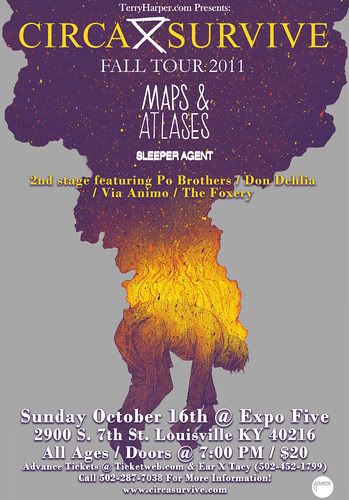
Maps & Atlases perform with Circa Survive and Sleeper Agent at Expo 5 on Sunday, Oct. 16. Show at 7:30PM, $20. Tickets available through ear-X-tacy and TerryHarper.com

*This is an extended interview. Read the condensed version at LEOWeekly.com
Photo: Drew Reynolds

10.12.2011

Good news for those who buy Ben Sollee tickets

10 VIP passes are up for grabs. Get off the fence already--10 first replies are wins!

Ben Sollee w/ Vandaveer
Headliners Music Hall
10/15 | 8PM, $20 + VIP upgrade

Travelling cellist and Kentucky native Ben Sollee plays Headliners Music Hall this Friday. If you've already thrown down the cash for a ticket in advance--congratulations! You're eligible to receive a Very Important Person privilege, courtesy of the nice folks of Crash Avenue.

What does a VIP upgrade entail?
Winners receive a wristband that grants exclusive access to the Headliners Mezzanine (including the bar on the Mezzanine) throughout the evening. Revel in the moment of VIP status.

Why Ben Sollee?
You've been hearing about him for months and have never checked out a show. Why not start here?


He returns to Louisville for what's likely to be sold-out show, so it would be ideal to buy your tickets, STAT! Replies accepted until 5 PM Thursday!

9.19.2011

Interview: Lessons with John Flansburgh of They Might Be Giants

They Might Be Giants returns to Louisville to send off the last Waterfront Wednesday of the year. The band's other half, John Flansburgh, takes a moment to discuss the new record and sketchy situations.

We may not be aware, but we have all experienced They Might Be Giants in one form or another. As a child I unknowingly witnessed their work watching Tiny Toons and Malcom in the Middle and never imagined I’d be coming back to question the entity behind it all. They were still an established band long before this time and have maintained strong output of inventive art that marks them a beloved act by all audiences. Leading the forefront of the inevitable internet-music marriage, they were the first artists to self-run an online music store and release albums exclusively in MP3. The past few years have kept them involved in mostly youth culture (get ‘em while they’re young) with their last three albums directed at children. Today, the two Johns tour in support of their latest adult TMBG album in four years, Join Us, which has been received surprisingly well according to John Flansburgh.

I caught up with John to discuss music and their upcoming show at Waterfront Park, a free event hosted by WFPK in their final Waterfront Wednesday of the season. Through the thousands of interviews past, it was clear he knew how to throw one down and made good company for a relaxed conversation. Flansburgh says he’s looking forward to be back in Louisville; this time TMBG is joined by Baltimore’s J Roddy Waltson & The Business and Louisville pop posse The Deloreans. Although there probably won’t be science lessons on the set list, it shouldn’t discourage you from bringing along the kiddies anyway. It’s an awfully generous opportunity with a free event of this capacity, and could seriously handicap your credibility as a human being if you neglected the legs/nubs you were born and failed to attend. A free They Might Be Giants gig is more of a right than an opportunity; don’t waste it!

You’re going to be doing a free waterfront show here in September.

Right, right. It’ll be fun to be back in Louisville. You know, Louisville used to be very much on the circuit of cities that we played. And I’m not sure if the rock club that put them on the map closed down or…I can’t remember the name of the rectangular room we played in.

Was it Headliners? [Note: I later came to find it was Tewligan's, which is now Cahoots]

No, it wasn’t. I forget the name it was called. In fact, the name might have changed a couple times, but I remember at one point we were still touring in a van, so it must have been the early 90s. And somebody—a fan—stole a license plate off our van which was such a drag, because it was at the beginning of a month of touring. We would have t-shirts drop shipped to us every five or six days and we’d have to go to an airport to pick them up. So we’d go to a local airport in some city and pick them up wherever the drop shipping place was. And one might not know this—but they’ve done it—if you drive a van without a license plate onto an airport, they know right away. [Laughs]

Basically they tipped off a crazy set of police alarm bells. But fortunately we had paperwork from the Louisville police saying that our license plate had been stolen, but you can’t get a replacement plate until you actually get back to the state where the vehicle was registered. So, we had to wait a month. And we were driving around for a month without a license plate, so we got pulled over like a half-dozen times, which really sucked.

Wow, that’s really sketch!

Well what’s weird about it is they were, officially, our friends, you know? They were fans who were getting a souvenir, “ha-ha.” So that month was really shitty.

So, about how many interview do you think you’ve done?

Oh, I don’t know, probably a few thousand. We’ve probably done almost 2,000 shows, and we do at least an interview per show. And that’s actually probably a conservative number. I’m used to it.

The current tour is in support of your new album Join Us, and I've noticed through your Twitter feed that several of your shows have been free events. For a band of your notoriety, it seems odd you aren't asking for any kind of admission. Any reason why?

Well, we did a big free show in Brooklyn right as the album was being released and that was just a very celebratory thing. You know, we do a free show in New York and there are 10,000 people so it’s a way to celebrate the release. This radio show [WFPK] is just something that’s having a big event and we’re taking part in it. There’s nothing better than a free show; it’s a great vibe. And you kind of super-size your audience when you play a free show. You get the music out to more people, so it’s kind of a win-win situation.

What are your favorites to play live?

Well, whenever you play a super familiar song, it gets a different kind of response from the audience which is exciting. But I think on a musical level, it’s always interesting to have new songs in the show, whether they’re from the catalog or it’s an old repertoire that you brought back or brand new songs. Right now there’s a bunch of brand new songs from the album and they’re getting a very warm response which is…unusual. But it seems like people are paying a lot more attention to this record than typical. The typical thing is kind of a time delay on how audiences respond to songs. Like when they’re brand new, they tend to be kind of quiet.

Most of them don’t know or care to know about them yet.

That’s to be expected, but over time they become equally beloved. Although I have to say, this record’s getting a very different kind of response. Even the first couple times we played songs in the past couple weeks, certain new songs have just gotten a really big reaction, so it’s very exciting.

I think it might also be because your last releases have been children’s albums.

Oh, yeah. And that’s like a different audience entirely really. We don’t really mix those worlds. The stuff we do for adults is strictly for adults and what we do for kids is certainly for kids. So the shows are very distinctly different. We’re not into generating that level of confusion.

Right. So you’d take a different approach to making a kids album?

The things that are different are the things that are the same. You know, the challenge of writing a good song is always kind of there. Those things have a lot of common elements. They sort of function differently; it’s hard to say what the difference is, but I wouldn’t say they’re completely different.

Who writes more of the music/lyrics?

Well, we’re both songwriters and then we collaborate on things.

Has it varied over certain albums?

It really varies from song to song, but by large we typically just pull our efforts into the project. There’s a lot of experimentation in the way we approach collaborating. It’s not like one of us is a music guy and one of us is a lyrics guy. I would say a lot of songwriters work in sort a painterly way and a sculptural way- they kind of throw stuff out there and let it pile up, and there are people who are into editing and the subtractive kind of pruning of ideas. There’s a lot of peeling back of ideas in our work. To try to figure out how to arrange a song is always a big question for us.

TMBG has always been ahead of the curve in terms of adapting technology and alternative ways to distribute music. Where do you see this heading? Do you believe that file-sharing is a beneficial part of music's digital transition or does it do more harm than enrich?

In terms of the business of music, once you take the money out of it, it changes the talent pool. There was a time when a lot of very bright people were running record companies, because they were professionally ambitious. You know, people tend to look at the business of music from a very…they think about the artist and they kind about audiences, but they don’t think about how it functions as a business. There are advantages to having file-sharing and there’s things that are nice about artists being able to make a living. The economics right now are very different. And having been picking around this—you know, my first job was working in a record store when I was 17 years old; I’m 51 now. I’ve seen multiple formats come and go. I’ve seen generational shifts, and there was this period where. People always sentimentalize things. The truth of the matter is, in the 1950's there was a lot of crooks involved in music. A lot of those crooks kind of got pushed out by more legitimate business practices over the course of 30 years as the business got bigger and more corporate. And it’s hard to say. People talk about the 50’s like it was a glorious era, but it was an era where the only people managing bands were crooks and the people running record companies were crooks. So, how great is a business when it’s all run by crooks? I’m a little bit nervous that as the money marches out of the music business, it seems very likely that the crooks will return. But that’s just a guess. The music business is a very strange one.

This is totally on the side, but an interesting point. People are talking about schoolteachers and they’re complaining about…ah, it’s too complicated to explain. But it goes back to the idea of talent pools shifting. If you think of all the great women who are doctors, lawyers, engineers and business people- all the women in the workforce right now were doing all these amazing things. And imagine that all those women in a different generation would be teachers. Think about what a change in the talent pools for teachers it is. Just generationally. In one generation, it’s gone from being teaching and nursing were the professions of women and now women are everywhere in the business world. If you’re a teacher, and they change the culture of teaching. Because you just don’t have the best and the brightest in your work pool. And I have to say, I remember when there was a time when everybody’s kid wanted to be an intern at the record company. And when that changed, I really felt like, oh, music isn’t the business of future.

I also noticed your music video output has slowed since ’92.

Well, we’ve done three full length DVDs for kids in the past five years. There all like an hour long animated music video collection. MTV doesn’t really exist anymore. We’ve done lots of music video-type things, but the old fashioned music video doesn’t have as many outlets.

It’s definitely losing its value.

Yeah. And the shift in outlets and value kind of made the budgeting a really confusing thing. If you’re an established band and you try to make a rock video, people immediately want to attach a zero to the budget where it might not normally be because your presence makes it a bigger deal. But still, it’s a world of $5,000 rock videos now. It’s not a world of $50,000 rock videos and it doesn’t really make sense for us spend a whole ton of money on videos when there’s no place for them to get played. And they don’t hold people’s interest that much.

How did you get a spot on Xavier: Renegade Angel?

Oh, I’m friends with the people who put that show together and they asking if I could come in and do a thing. It’s very crazy.

What are your thoughts on the show? Did you have a fun experience?

It was very, very strange. I spent like an hour screaming at the top of my lungs. The production company that does those shows [PFFR], they also did Wonder Showzen, and they’re very creative people with loopy ideas. They’re neighbors of mine; just nice people.

It’s great; it really is. Do you have any current side-projects in the works?

No, we’re going on the road for six months, so my side-project is gonna be eating chicken wings at three in the morning.

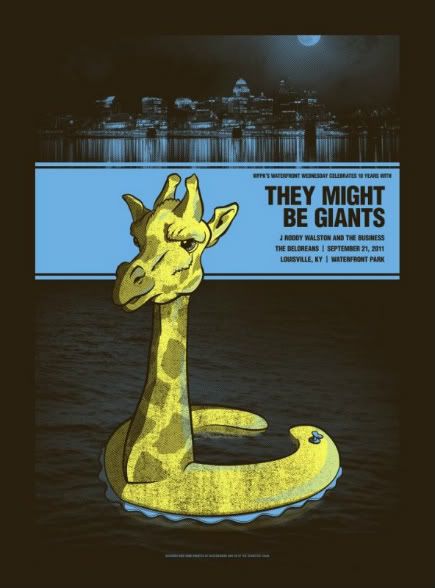
They Might Be Giants will be performing with J Roddy Waltons & The Business and the Deloreans at Waterfront Park on Sept. 21st. Admission is FREE and all ages.

*This article also appears at Louisville.com.
Photo: Lastfm/TMBG photo album

9.12.2011

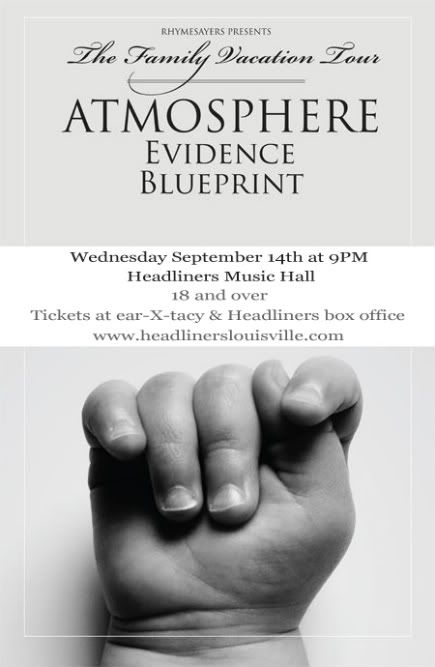
Interview: Slug of Atmosphere and the Family Vacation

Atmosphere stops at Headliner's this Wednesday, Sept. 14th on vacation with labelmates Blueprint and Evidence. Sean Daley, the other half of Atmosphere, speaks about Eddie Murphy, his six day stint in Deep Puddle Dynamics and crybabies.

With Atmosphere as the driving force behind the movement of Twin Cities hip hop, Minneapolis breeds more than just bodies of water. It plays host to a thriving music scene of issue conscious rapppers and those willing to put their stories out there in a style defined by its candor and eccentricity. Under the umbrella of Rhymesayers Entertainment—a hip hop label founded by Atmosphere, Brent Sayers and Musab Saad—these artists are given a central hub to release records. However, you won’t catch them hanging around the office for a grip as they are currently on vacation with labelmates Blueprint and Evidence. Louisville will be one of the last handful of stops left on this excavation, a journey that began in Chicago at Lollapalooza and eventually brought them full circle around the nation. It was a really scattershot circle, though.

The tour is named after a signature hand gesture devised by Slug’s son, a gesture so commonly occurred that they decided to put it on the cover of their new record. Following up on the facts of life within 2009’s When Life Gives You Lemons, You Paint That Shit Gold, things begin to get really slow. Usually this fixes everything; imagine any song with a beat and slow it down…that’s TENSE. Now, imagine the flow over top of this track spoken without much aggressive emphasis…that’s DYNAMICS. It doesn’t make much sense compared to the hip hop standards of violent subject matter and themes, but Atmosphere have been managing this sub-standard for a while. Piano trails littered the loungy, low-key nature of their last record, but now they’ve exchanged their coffee banter vibes with slithering psych-rock influenced platforms that conjure up enough texture to create its own natural system. In terms of where in the atmosphere this layer lies, it's the sub-stratosphere.

I didn't get into the scientific side of their music, but I feel some spark from Slug's very blatant answers. My spirit was crushed to hear Slug dismiss Deep Puddle Dymanics as a joke and was equally confused as to whether rewriting Eddie Murphy's "Boogie in Your Butt" is actually an ironic thing to do. I found him to be an extremely sincere guy serious with a respect for all art and the different purposes they serve.

I’m conducting this interview in the back kitchen of a head shop in Louisville. Where’s the strangest place you’ve done an interview?

I don’t know if I’ve ever done one in any strange places. Usually it’s over the phone, so it’s somewhere convenient.

That’s good. I’ve only seen a couple video interviews of you. I remember in one of them you said you became interested in writing hip hop from rewriting a really bad Eddie Murphy song…? Do you think if you chopped and screwed Kenny G it’d be any good?

I doubt it.

Is there no way of making it good?

No, I think it’s because the only reason someone would chop ‘n screw a Kenny G song would to be ironic, and I don’t think irony makes for very good art.

So you genuinely loved the Eddie Murphy song?

Which Eddie Murphy song-“Big Ol’ Butt?” “Put It In the Butt?” Yeah, that’s a great song- are you kidding me?

I’ve never heard it, but it’s definitely on the list to check out. (Note: I later came to find it’s titled “Boogie in your Butt,” something Eddie Murphy was not down with in the song.)

How does working in Atmosphere right now differ from your former rap group Deep Puddle Dynamics?

Deep Puddle Dyanmics was never a group. It was a thing, a side project that we did in 1998, but I’ve been in Atmosphere since 1989. Atmosphere has always been my group that I’ve been in. And then, a couple of dudes got together and said hey, let’s do this side project called Deep Puddle Dynamics and so we did that, and it was just a one-off. We only did one show because we all live in different parts of the country, so it was never really a group; it was just more like a recording project we did one time.

I meant that it was a group of people and collective effort.

Deep Puddle was never really work though, I don’t really know how to describe it. It was four guys who, for one week, smoked a whole bunch of weed and made a record. And so there’s really not a whole lot. Whereas Atmosphere is more like a machine, you know: a touring machine, recording machine. With Atmosphere I’ve put out about 7 official records, but we’ve put out about 15 records realistically. And Deep Puddle was something that lasted for six days. That’s what I’m saying, Deep Puddle wasn’t really a group, it was just a…a joke.

Well… I thought it was great.

Deep Puddle? Huh. That’s interesting.

I listen to it very often, actually.

You do?

Yeah, to this day.

Wow- right on, right on.

I just wanted to throw a question out there- I was genuinely curious.

I guess if I had to say it was different, I’d say that with Deep Puddle we didn’t really think about what we were doing. We were just doing whatever happened. We were under the pressure of time and six days together to make a record and so we just kinda did what happened without giving it too much thought. Whereas with Atmosphere, everything we do is very thought out; there’s a point to everything we do with Atmosphere.

I guess that’s why I like it- imperfect sound.

Right.

But with your newer stuff I noticed it’s becoming more positive- how have your audiences been responding so far?

So far, so good. Every time we make a record people have a tendency to go, “well I don’t know. I’ll really have to listen to it a couple times.” And then usually six months later they go, “wow this is great.” And I think this record is no different. When it first came out, everybody was like “well, it’s a little different, I don’t know,” and now that we’ve been out here for four months on the record everybody’s been starting to come around to it. I think people have this tendency to think they know us, or they know me. And so whenever I do something they think is outside of me, it’s like, they don’t know how to deal with it. They just all want me to be that guy that’s rapping about Lucy, and I haven’t mentioned Lucy on a record since 2002. So, Lucy’s been gone for about ten years. So when I quit doing it, cause I knew I had to move on and do something else—you can’t keep doing the same shit for more than two years, otherwise you’re a sellout—so, when I moved on…it’s like, audiences don’t move on. Things are timeless. Somebody today is hearing that Lucy shit for the first time ever, so they don’t put a time stamp on it. So you know, it’s more about when you take it in or how you take it in. For me, it’s more like it’s a straight line. Not a circle. And I guess that’s how it is for artists; they live on a straight line, however, for those of us that appreciate art you know, it’s circular, it’s a cycle.

Among your influences, what is the constant drive in your life?

Just my surroundings- the people that I’m surrounded by. I usually just steal my inspiration from my immediate surroundings.

What are your feelings on file-sharing? Do you believe it's beneficial to the music community or does more harm than good?

I don’t think I’d call it either; it’s just a way of the world, you know? It’s just the way things are today. When I was a kid we used to make mix tapes and share music with each other. People are always going to share music; that’s part of why music exists. I think that artists are being crybabies about not making any money because of file-sharing, because 100 years ago before the music industry existed, you would be lucky to get a pillow to lay your head on a bowl of soup for being able to sing a song. And then somebody invented this big scam called the music industry and a bunch of people got rich. Now, those rich people aren’t making as much money than they used to and they’re being little crybabies about it.

When you're writing, are you attentive to the pronunciation in how it affects the song in a sculptural way, or do you focus more on the words and their meanings?

I’d say, both.

Do you ever take breaks from writing or is it always a constant thing for you?

I take a break when I’m on tour.

Have you been through Louisville before?

Many, many times.

Any distinct memories?

None that I would talk about publically. I do like the airplane shoved into the side of the hill over there at Headliner’s.


Atmosphere will be performing with Blueprint and Evidence at Headliners Music Hall on Wednesday, Sept. 14th. Tickets are $20, available through ear-X-tacy, Headliners box office and Etix.com. Doors at 8PM. 18+ with I.D.

*This article also appears at Louisville.com
Photo:Lastfm/Slug photo album

8.04.2011

Gig review: Tech N9ne at Expo 5, Louisville

Tech N9ne says that 6's and 7's stands for disarray and confusion. After rolling through Louisville last night with a crew of fellow artists off his label, Strange Music, some [children] might have felt that way.

8.3.11
There was already juggalo drama afoot upon my arrival to Expo 5, a venue that strangely resembles a deserted carnival even when no ICP fans are around. Offhand comments from police proved this to be the norm- “This is like an ICP crowd…” while a group of well decked-out fans were escorted outside the gates before the show kicked off. I found comfort in seeing younger fans, hoping that this would entice rowdy adults to calm their shit. Unfortunately, the term All Ages is only meaningful to those who haven’t quite peaked enough to buy cigarettes yet.

Tech N9ne rolled through Louisville last night with a large crew of fellow rappers to support his headlining tour, but they reassured us this was a party and not merely a performance. Stevie Stone initiated the night’s baller vibe, layin’ out the crunk…and yelling. The following act Mayday! succeeded at appeasing both rock and hip-hop lovers with their Beastie Boys delivery and ska/punk style, though it did border dangerously along Limp Bizkit territory.

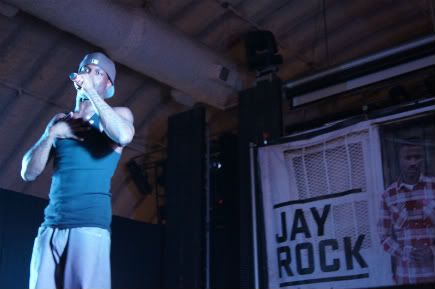
Jay Rock did a brief set with material from his latest Follow Me Home, but brought nothing memorable besides an intense flow spat on his closing song. Kutt Calhoun was able to raise several hands with his single “Buy the Bar” and eventually Stevie Stone got back onstage as well. It appeared as though everyone had each other’s backs within stage banter that occasionally felt like watching a conversation aimed directly at us. Upon opening or closing a set, each artist dedicated their performance to a deceased fellow with the mysterious initials M.J. The party was for him.

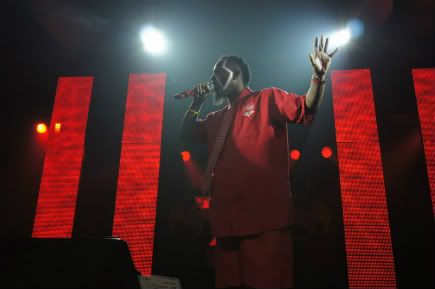
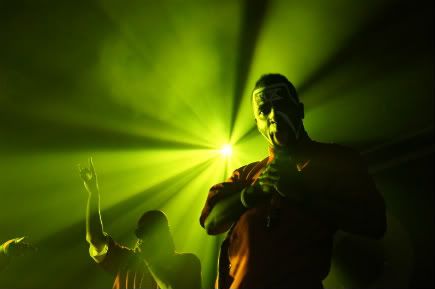
However grueling it may sound, the slew of opening acts didn’t faze the patience of Tech N9ne fans. He entered the stage through an automatic door built within the giant red 9 that stood behind him, wearing matching Strange Music jumpsuits with the 816 Boys who are known for accompanying him on the single “Areola.” I definitely had the female advantage as Tech gave my camera extreme eye contact and followed my movement in front of the stage. The set was a chopped mix of old and new material, busting out with the first verse of “Worldwide Choppers” as he warmed up the crowd. There was no avoiding that some incarnation of “Midwest Choppers” would make an appearance (which has become a Technition anthem), but they only went as far to throw down part II in its entirety. “Psycho Bitch” was interrupted with “Psycho Bitch II,” and “Red Nose” was performed humbly by Tech sitting down. “Come Gangsta” also brought forth the unifying pride that this fan base shares. Of course, any fan could tell you what Tech N9ne’s favorite drink is; so when it was time to sing the ingredients in “Caribou Lou,” nobody had to tell the bar twice. On perfect timing, a pale yellow mixed drink was passed up to the stage once the song had concluded. Eventually it broke down to a mad-lib test of who Tech N9ne’s real fans were as he recited random lyrics from older songs like “Dysfunctional” to “Low” and allowed the crowd to fill in the blanks.

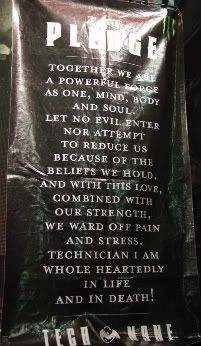
Things started getting pretty sloppy in the crowd and Tech definitely had this in mind while determining his setlist. 1) Convince everyone it’s a party, 2) Bust out “Areola,” 3) Demand women to flash titties. One poor soul ended up on stage lugging a pair of size infinite DD’s on her chest and showing them to whomever didn’t already have their head turned away. Even with this vague excitement, the show remained pretty anti-climatic until the evening came rolling to an end and he sang an excerpt from an unreleased track called “F.A.N.S.”- You are my heart/you are my soul/Thank you for all you’ve done for me. The big finish: Tech passing out free cans of Monster and a recital of The Pledge.

But just look at these photos!


*This article also posted on Louisville.com

Photos: Lara Kinne


7.19.2011

Interview: Matisyahu, reggae's most spiritual Jew

His name means "gift of God," his beard means business, and he's performing at Headliners Music Hall this Thursday, July 21st. Matisyahu speaks about Judaism and recording in Louisville.

Much like his Hasidic beliefs, Matisyahu communicates his message through telling stories, or adapting old ones. He cites the Torah as the influencer of his words while his music dwells primarily in reggae and hip-hop, but they have more in common than you think.

This Thursday Matisyahu will perform with electronic duo Sub Swara at Headliners Music Hall, however, he is no stranger to Louisville. Among his last few stops here included a recording session downtown that later became The Louisville Light Sessions EP, a collection of select tracks from the 2009 studio album Light.

While Light embraces the wonders of electronic manipulation and multi-track recording that creates a lush texture, it seems to have left part of the funk behind. That isn’t to say that the organic feel of his live performances don’t suffice enough funk to bring the house down. A live album recorded in Austin, Texas during 2005, Live at Stubb’s, peaked #1 on the Reggae Billboard charts before the young artist even released his second studio album. The impressive beat-boxing and intricate vocal patterns can easily entice a listener to check out a live show and witness these songs in action, many of which appear on his definitive record to follow, Youth. Of course homage to Bob Marley is paid in the couple acoustic ballads that are nestled into this empowering album, and only one song title with the word Zion. The rest is a funk-infused call to action, minus the love song “Unique is my Dove" which can be referenced back to his marriage nearly seven years ago. He now tours with his family of three and band to promote his latest, Live at Stubb’s Vol. II, a second take at the same Austin venue that helped launched his career, now six years later.

I spoke with Matisyahu over the phone while in Chicago and he was very patient with the brief connection issues we had to accommodate. Immediately I was at ease knowing that I’d be speaking to someone less concerned with how much time or money they don’t have. In fact, money wasn’t even brought up despite trying to get him to talk about file-sharing.

How has touring been this year? Does the experience improve over time or does it differentiate between cities?

It has improved tremendously, actually. I’ve always loved performing, but there was definitely a time when I knew less. It’s like anything; you grow with it. All the different elements behind it: going from being able to create the right space around you, adjust to being on the road, and having the right people around you- in terms of the band and people working for you, having more knowledge of my instrument, and being able to connect with the fans. I find that when time goes on, I really find myself enjoying it more and more every tour.

Do you ever feel like the fact you’re a Jew is abused subject matter in an interview?

No, I think it’s fine. It depends on the interviewer and what their interest is. One of the best interviews I did was the other day for a daily newspaper in Pittsburgh, and the interviewer was Jewish, and I think he was pretty connected with his Judaism and therefore had a lot of in-depth questions about my Judaism. I don’t mind discussing it.

Well, I’m about to throw a few at you. What significant experiences led you from being raised a Reconstructionist to an Orthodox Jew?

There were a few that I could suggest, but all of them would require an interview for each experience. It’s something I don’t really like to over-simplify. Would you like me to pick out one of them?

Yeah, if you could.

Overall it was a very organic experience for me. It wasn’t an overnight thing; it was the type of thing that really grew over time. When I was a teenager I started listening to Bob Marley and reggae music, and I really felt all the references to Judaism in there to the Old Testament in the lyrics of those songs. And the spirituality there. A lot of it is influenced and borrowed from Judaism and the Torah. So that was one of the initial draws to me: to explore Judaism on a deeper level. That’s one thing.

Another was when I moved to the west coast to Oregon and found myself to be one of the few Jews in the town I lived in. So I felt all of a sudden, going back from New York, this sort of… I guess at that time in my life, being in my late teens, I was looking for my identity. I felt that being Jewish was a big part of that, even though this wasn’t exploring religiosity, but it made me feel a connection to Judaism. Now when I was 16 I also went to Israel to and experienced a lot of Judaism and young American Jews, too. Israel was very different from the Judaism that we’re exposed to in America. Somehow it feels much more authentic over there. And the variety of Judaism that’s available is appealing.

In college I took a class on race studies. All of us white kids, we were taking the class expecting the black kids and the black teacher to tell us what it’s like to be black in America and be in those situations where there’s racism. And on the contrary, the teacher wanted us to talk about what it was like to be white in America, what it meant to be white and to really explore our identity. It was around that time that I began to really feel a spiritual pull, and an emotional pull from a lot of different directions towards Judaism. I decided, partially because of influence from that teacher and class, that I wanted to wear a yamaka. And let the outside world know that I’m Jewish rather it be a secret and something I keep to myself.

Now, do you find yourself identifying with more than one type of Judaism or religion?

Yes, to a certain extent. Judaism isn’t just a religion, it’s a people. So in that sense I find myself relating to all Jews. Coming from a cultural perspective, as people, yes. Coming from a religious standpoint, I don’t really identify or connect with reformed Judaism or reconstructionist as much, or conservative Judaism. I believe that the Torah’s the real deal; it’s the real thing. Within Orthodox Judaism there’s different branches, so I do find myself sort gravitating towards Hasidic and Kabbalistic thought, employing from those places mainly.

There is a Jewish fusion band called the Shirim Klezmer Orchestra that take the plot-lines from Jewish folk tales and play out the stories in their music. Have you ever adapted a folk tale to write a song?

The last studio release I put out is based on a story called The Seven Beggars which was written by Rabbi Nachman who was a Hasidic rabbi. He was the grandson of the Baal Shem Tov, who was the founder of the Hasidic movement and that was in the late 1700s. He basically believed that people weren’t really connecting to the Torah. The learning wasn’t real to them. Therefore it started creating an impediment between them and God. And therefore he felt that there needed to be a new revolution in Torah learning and that it had to come through stories, and so he began to tell these stories. I studied his work for about three or four years and it culminated in my records, based on one of his stories called the Seven Beggars.

What are your feelings on the digital transition to music, i.e. file-sharing? Have you been effected by the fact that people can download your music without paying or do you believe this transition has enriched the music community?

I think it does both. It allows music to get out there easier and in some ways…well, you know the story; you know how it works. I’m sure you’ve read plenty of articles about it.

Well, what solution would you offer on behalf of your music?

I don’t have a solution because I don’t really see it as a problem. Things just are what they are. It’s just the reality of: why are leaves green?

Do you go back to the holy land very often?

Yeah, I’m usually there two to three times a year.

Anywhere particular that draws you there spiritually?

If I’m there during the high holidays I usually stay in Jerusalem.

Do you have any distinct memories of your time in Louisville?

Yeah, we had a recording there called Louisville Light. This band that I was playing with at the time, we decided we wanted to record the songs from [Light] live. So we took a little break on the tour and stopped at a studio in downtown Louisville and spent I think four or five days there. Or was it three?

Also while I was there I spent some time over Shabbat by the Chabad. You know, just a normal Chabad house…nothing special.

Matisyahu will be playing with Sub Swara at Headliners Music Hall, July 21st @ 8PM. Tickets are $25 available through Headliners, ear-X-tacy and etix.com. 18+ with I.D.

FREE Matisyahu in-store performance and meet&greet at ear-X-tacy Records prior to show starts at 6PM.

Photo: Courtesy of MatisyahuWorld

*This article also appears at Louisville.com

6.16.2011

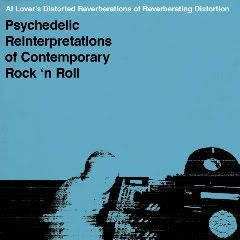
Al Lover- Distorted Reverberations (of Reverberating Distortion) (2011)


An essential part of keeping community alive in music is the remix: the act of artists reinventing another's work into their own. With Al Lover's new project in producing hip hop beats reworked from current psychedelic and garage bands, he helps to further bring a sense of connection within underground music. His last project was in the similar vein of remixing rock 'n roll as he produced Safe as Milk Replica last year, a tribute to the late Captain Beefheart. Adhering to his mission to extend the music community, all of these mixes are offered for free through Al Lover's website...and now on Huevos. Lay down a flow or let the beat ride, and enjoy the sound of legal- the way it should be.

1. Natural Child- "White Man's Burden"
2. Shapes Have Fangs- "Terlingua"
3. Oh-Thee-See- "If I Stay Too Long"
4. White Fence- "Sticky Fruitman Has Faith"
5. King Tuff- "Sun Medallion"
6. JEFF the Brotherhood- "Hey Friend"
7. Ty Segall- "Fist Heart Mighty Dawn Dart"
8. Davila 666- "Yo Seria Otro"
9. Night Beats- "H-Bomb"
10. Moonhearts- "I Can Go On"

6.08.2011

Gig Review: Bright Eyes/Dawes at Iroquois Amphitheater, Louisville

6.7.11

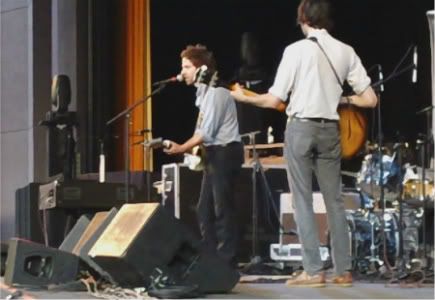
It was a beautiful summer evening to hear great music at the Iroquois Amphitheater last night. Conor Oberst must have been feeling the buzz too, because I wasn't expecting a Bright Eyes show to be so heavy. Sharing the stage with them were Dawes who released their second album yesterday and performed at ear-X-tacy before last night's show. They come close to a modern Band with California style that pulses straight out of their bluesy, Malibu roots.

By sunset, it was time for Bright Eyes to take the stage. Having never attended one of their shows before, I was expecting a mostly Conor-centered experience. But the addition of a larger band aided songs dating back to I'm Wide Awake and Lifted to sound more fleshy and vibrant than their studio counterparts. He often played around the wording of these older tunes and didn't appear bored from playing them over the years. Moreover the defiant nature in his earlier music wasn't lost, but became more refined and powerful.

Even though there was only one "MARRY ME CONOR" sign, it was clear that his fanship runs deep in Louisville. To many, he is presented as a prophet. It's a unique trait he has always been able to maintain as a songwriter; people tend to hang on extra hard to his words. In the instances where Conor performed without the band ("Poison Oak," "Lua") to a quieted amphitheater, you could hear shouts of approval and agreement amongst the crowd as if he was preaching to us some kind of truth. The raw subject matter in his songs definitely make it seem that way and one could easily get lost in the emotions they may evoke. This only goes to show what a great songwriter he truly is, unknowingly touching the hearts of many people young and confused.

Conor has had past connections to Louisville as he collaborated with MMJ's Jim James in Monsters of Folk and played at Headliners last year. He explained that "A Machine Spiritual" from the new Bright Eyes record was inspired by Jim and dedicated its performance even though MMJ is currently off touring. The set ended with a cheers to the audience in "One for You, One for Me," the closing song on The People's Key and an inspiring wrap-up for the encore.

Bright Eyes- "Four Winds"

*This article also appears at Louisville.com
Photos/Video: Lara Kinne